Why didn't my passport get stamped? A country-by-country guide (2026)
More than a dozen countries have stopped stamping tourist passports by default, and 29 European countries just joined them. Here's who stopped, when, and what to do if you collect stamps.
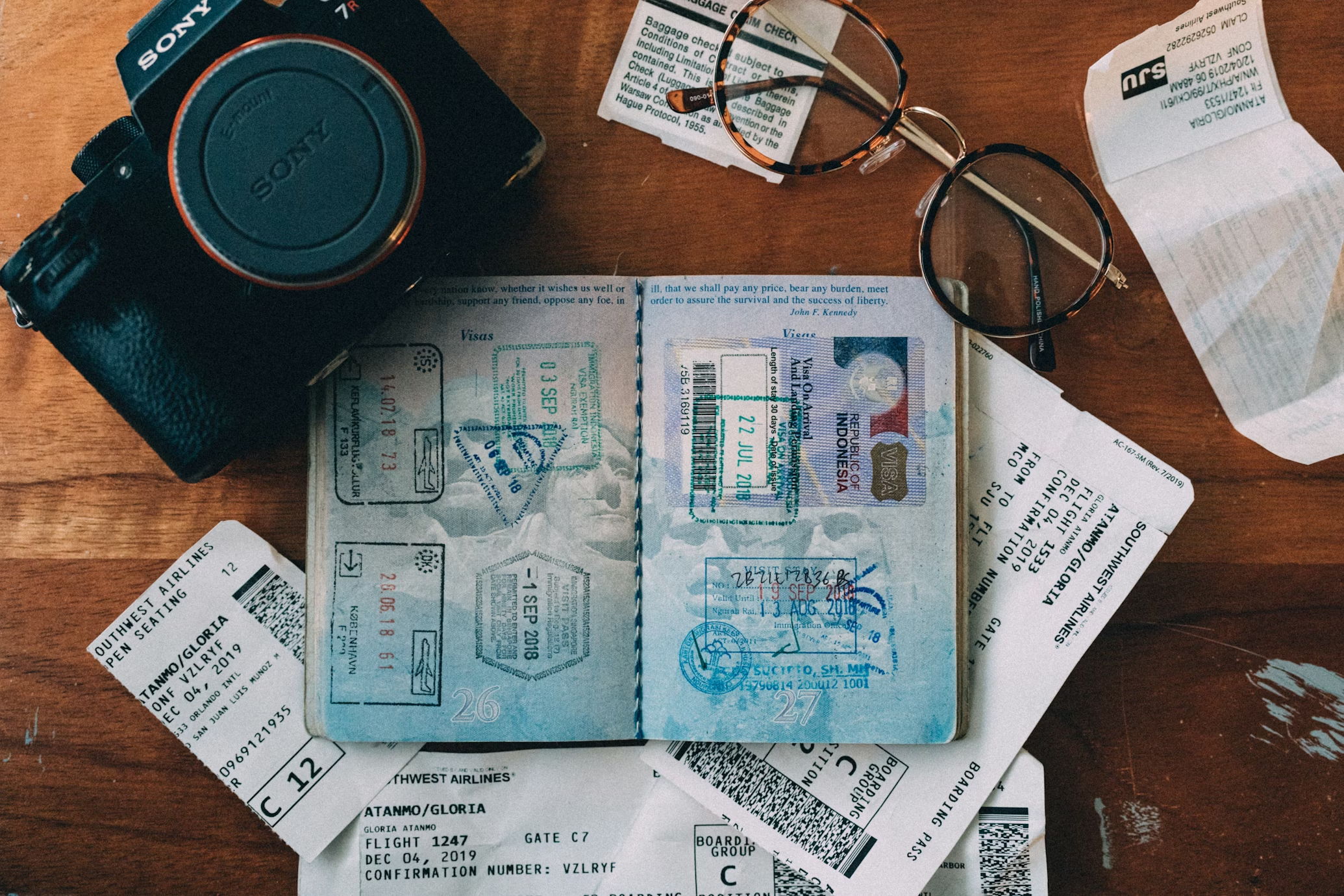
You arrived. The officer barely looked up, scanned your passport, and waved you through. No thud of the stamp. No fresh ink to flick through on the flight home. If you've felt that small letdown, you're in good company. The border stamp is quietly disappearing, one country at a time, and most travelers only notice when they flip to a blank page that should have had something on it.
This is the full country-by-country picture: who has stopped, when they stopped, what they use instead, and where you can still walk away with ink in your book.
TL;DR
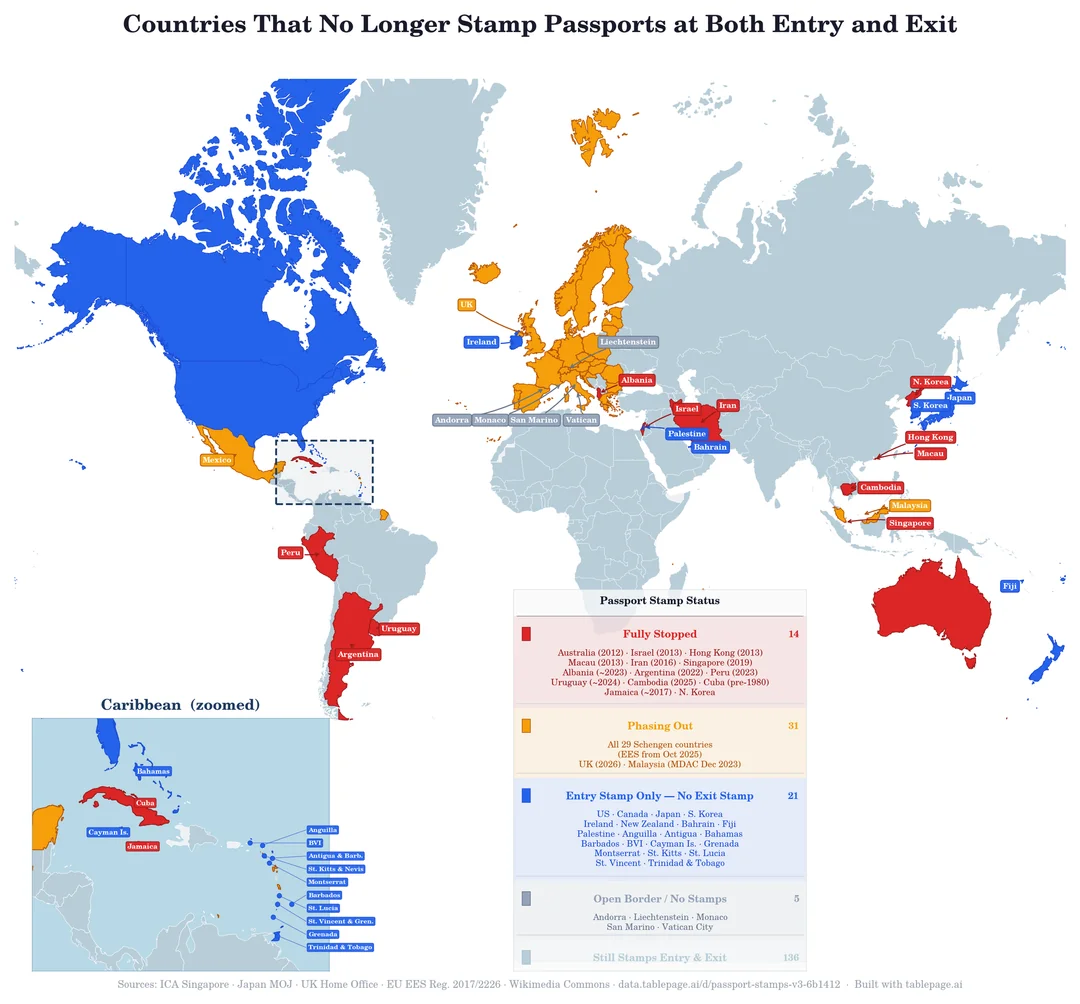
More than a dozen countries have stopped stamping tourist passports by default. In some, you can't get ink even if you ask nicely. In others, the e-gate is simply the default lane now, and you have to seek out a human officer to get a stamp at all. And as of April 2026, 29 European countries swapped the stamp for a digital border record in one go. The rest of this guide walks through them.
Why it's happening
It comes down to speed and security. A digital record is faster to process at a busy border than a person flipping through pages and hunting for a clear spot to stamp. It's also far harder to forge than ink, and it lets a country count exactly who is inside its borders and for how long. Once a border agency builds the database, the stamp becomes a slow, redundant tradition. So they retire it.
For a lot of us the stamp was a souvenir, a little proof of where we'd been. For the border, it was mostly admin. Now that the admin side has moved to a computer, the souvenir is quietly going with it, even though that was never really the point of dropping it.
Peru (2023)
This is where it all starts for me. I went to Peru in 2023 hoping for that classic border stamp, and the officer at Lima's Jorge Chavez airport just scanned my passport and waved me through. No ink, no ceremony. I stood there for a second waiting for it, then realized it wasn't coming.
Peru officially stopped stamping passports at its airports and seaports in May 2023, moving to a digital migration record instead. Fly into Lima, Cusco, or Arequipa and you'll get nothing in your book. Land borders are the one exception, they still stamp, so an overland crossing from Bolivia or Chile can still earn you a mark. But for most visitors arriving by air, the airport stamp is simply gone.
The only stamp you'll leave Peru with now is the souvenir one at Machu Picchu, a little llama and ruins design you ink yourself near the entrance. It isn't an official border mark and it means nothing to any immigration officer. But it's a lovely keepsake, and honestly, that small gap between the stamp I wanted and the souvenir I got is the exact moment that started Stampie.
Here's the digital Peru stamp we made for your Stampie passport.

Argentina (2022)
Argentina got there before Peru. It scrapped entry and exit stamps on 25 April 2022, for everyone, tourists and Argentines alike. Your crossing is logged in a digital record you can actually look up online afterward, which is more than most countries offer. Buenos Aires airports led the change, with land and sea borders following. Cross at Iguazu or fly into Ezeiza and the result is the same: a clean page where the stamp used to be.
Here's the digital Argentina stamp we made for your Stampie passport.

Israel (2013)
Israel was an early mover, and for a very specific reason. Back in 2013 it dropped passport stamps in favor of a small paper slip you keep loose with your passport. Blue on the way in, pink on the way out. Airports switched first, and the land borders caught up over the next few years.
There's a practical reason it matters here more than most places. An Israeli stamp in your passport can get you turned away at the border of several Arab and Muslim-majority countries. The loose slip solves that neatly: you get a record of your visit, you can throw it away if you need a clean book for your next trip, and nothing permanent ends up in your passport. It's still the tidiest version of the no-stamp policy anywhere.
Here's the digital Israel stamp we made for your Stampie passport.

Hong Kong and Macau (2013)
Both of these stopped in the same year, and both swapped the stamp for a slip of paper. Hong Kong stopped stamping arriving visitors on 19 March 2013, handing out a small white landing slip with your details and permitted stay printed on it. Macau followed that July with a printed Slip of Authorization to Stay, and dropped the old arrival card at the same time.
Keep the slip somewhere safe while you're there, because it's your proof of legal entry. But don't expect it to survive as a souvenir the way a stamp would. It's a receipt, not a keepsake.
Iran (2019)
Iran's case is pure travel politics. You'll see 2016 listed on a lot of travel sites, but that date doesn't hold up. The real change came in 2019, when the president ordered border officers to stop stamping foreigners' passports, and by that August it was in force at every land, sea, and air border. Officers stamp a separate visa sheet instead, so nothing goes in the passport itself.
The logic mirrors Israel's. An Iranian stamp can complicate entry to some other countries, and an Israeli stamp blocks entry to Iran, so a clean book keeps the most doors open for the most travelers. Two countries on opposite sides of a political line, landing on the exact same paperwork solution.
Singapore (2024)
Singapore took automation further than almost anyone. Some lists date this to 2019, when the plan was first announced, but the passport-less gates didn't actually go live until August 2024. That's when Changi rolled out token-less clearance, using face and iris scans to identify you at the gate. First-time visitors still present their passport once on arrival, then clear by biometrics and a QR code on later trips. Either way, there's no stamp, and increasingly there's barely a passport involved at all.
It's a glimpse of where a lot of borders are heading: your face becomes the document, and the little book in your bag is just a backup.
Here's the digital Singapore stamp we made for your Stampie passport.

Australia
Australia has leaned on SmartGate face-recognition lanes for years, and they're now the default channel for ePassport holders both arriving and leaving. SmartGate doesn't stamp. You walk up, look at the camera, the gate opens, and you're in.
There's still a staffed counter where a human officer can stamp you if you ask, but you have to go out of your way for it. The gate is the path of least resistance, and most travelers take it without thinking, which is exactly how the stamp quietly vanished from millions of Australian trips.
Here's the digital Australia stamp we made for your Stampie passport.

Cambodia (2025)
Cambodia is one of the most recent to make the switch. It replaced the immigration stamp with a digital "v-Pass" that arrives by email. The system ran as a pilot from January 2024 and became mandatory on 1 July 2025 at the country's airports and international border posts. You fill in your details online, you get a digital pass, and you clear the border without anything landing in your passport.
For a country whose Angkor Wat stamp used to be a backpacker trophy, that's a real shift.
Other countries that no longer stamp by default
A few more belong on the list, each for slightly different reasons.
Cuba has long avoided inking tourist passports, partly to shield US travelers from awkward questions back home, stamping a separate card instead. From January 2026 it replaced that paper card with an e-visa and a digital arrival record, so the passport still stays clean.
North Korea issues tourists a separate visa sheet rather than stamping the passport, so there's no DPRK mark to explain at your next border. Tourism there is mostly closed in 2026 anyway, so it's a fairly academic point for now.
Jamaica moved to a digital entry process around 2017 and no longer routinely stamps arrivals, though a human officer may still oblige if you catch their eye and ask.
Europe: the big one (EES, 2025 to 2026)
If every change above is a stream, this is the river they all feed into. The EU's Entry/Exit System (EES) is the largest single change to passport stamping in decades, and it covers a whole continent at once.
EES replaces the physical stamp with a digital record of your face, your fingerprints, and the dates and places of your entries and exits. It applies to non-EU travelers on short stays. It started rolling out on 12 October 2025 and became fully operational on 10 April 2026, running across 29 European countries: the Schengen members plus Iceland, Liechtenstein, Norway, and Switzerland.
For collectors, this is the heartbreaker. A trip through France, Italy, and Spain used to mean three crisp stamps. After EES, it means three biometric scans and a blank passport. The upside, if there is one, is no more frantic page-flipping at a busy border. The downside is obvious if you've ever flipped back through old Schengen stamps and remembered every trip in a glance.


United Kingdom
The UK runs more than 270 eGates across 15 air and rail ports, and eligible biometric-passport holders are routed through them by default. The gates don't stamp. Walk up, look at the camera, walk through.
If you want a stamp, you can still get one, but you have to act before you leave the airport: find a Border Force officer at a staffed desk and ask. Once you're past the gates and out into arrivals, that window has closed.
Here's the digital United Kingdom stamp we made for your Stampie passport.

United States
The US has never stamped on exit, so the only stamp Americans and visitors ever cared about was the entry one. That's going too. Since 2022 a growing list of airports log your arrival on a digital Form I-94 instead, which you can pull up online if you ever need proof of your entry date.
Global Entry and mobile-passport travelers usually skip the stamp already, gliding through a kiosk or an app. If you want ink, the move is the same as everywhere else: go to a staffed counter and ask an officer directly.
Malaysia (2024)
Malaysia is a useful one to get right, because the change that killed the stamp isn't the one people talk about. The Digital Arrival Card (MDAC), required since January 2024, is just an online form you file before you land. It doesn't touch your passport.
The thing that actually retired the stamp for many arrivals is the automated autogate rollout that followed in June 2024. Clear through an autogate and there's no ink, and no officer counting your days, so you need to track your own permitted stay. Go to a manual counter instead and you may still get stamped the old way.
Where you can still get a stamp
It's not all gone. Plenty of countries still stamp by default, especially at land borders, smaller regional airports, and quieter crossings where automation hasn't arrived. If collecting matters to you, a few habits still work:
- Skip the e-gate. Where a staffed counter exists, choosing the human lane and asking politely is the single most reliable trick.
- Cross by land. Land borders are the last stronghold. Peru, for one, still stamps overland even though its airports don't.
- Chase the souvenir stamps. Machu Picchu, Easter Island, Galapagos, Antarctica research stations, and dozens of national parks offer unofficial stamps that are pure keepsake. They mean nothing to immigration, which is exactly why they're fun.
Have a small reason ready if an officer hesitates. "I collect them for memories" is true, harmless, and works more often than you'd think. Just know that in the countries that have fully stopped, Hong Kong, Macau, Israel, Argentina, Peru by air, Iran, Cambodia, the answer will be a polite no. The ink simply isn't there to give.
What this means if you collect stamps
Here's the quiet truth of it: the stamps you already have are now a finite collection. The borders that gave them to you mostly won't again. That makes the pages you've filled more meaningful, not less.
Plenty of travelers are reacting by preserving what they've got and recording the trips that no longer leave a mark. Some scan their old stamps. Some frame a favorite page. Many keep a digital journal like Stampie, marking each country once they've been there, so the record survives even when the passport stays blank. The stamp may be disappearing from the book, but the habit of remembering where you've been doesn't have to.
FAQ
Why is there no stamp on my passport? Almost certainly because you went through an e-gate or automated kiosk, or you arrived in one of the countries that have stopped stamping altogether. It's not a mistake, and it doesn't mean anything is wrong with your entry.
Is no passport stamp normal? Yes, increasingly so. The list of countries that have dropped the stamp grows every year, and Europe's switch to a digital border record in 2026 made it the new normal for a whole continent at once.
Which countries have stopped stamping passports? Hong Kong, Macau, and Israel (2013), Argentina (2022), Peru (2023, at airports and seaports), Iran (2019), and Cambodia (2025) have replaced the stamp with a slip or a digital record. Australia, Singapore, the UK, the United States, and Malaysia now default to automated gates that don't stamp unless you go to a counter and ask.
Which countries stopped stamping recently? Cambodia made its digital v-Pass mandatory in 2025. The EU's Entry/Exit System replaced stamps with a digital record across 29 European countries, fully live from April 2026.
Does the United States stamp passports? The US stamps on entry only, never on exit, and it's now phasing out even the ink entry stamp in favor of a digital Form I-94. Global Entry and mobile-passport travelers usually skip it. Ask an officer at a staffed counter if you want one.
Can I still ask for a stamp? In countries that haven't fully stopped, yes. Skip the e-gate, go to a staffed counter, and ask. In the countries that have ended stamping completely, no amount of asking will produce ink that no longer exists.
Sources
Key dates link to their source inline above. The rest:
Behind Stampie

The idea for Stampie started in Peru 🇵🇪, back in 2023. I’ve always loved collecting passport stamps, that small thrill of seeing a new one land at the border. On that trip they just waved me through. No stamp. A small thing, but it stuck with me.
Turns out a lot of countries have quietly stopped stamping. A couple of years later I built the first version of Stampie for a hackathon, somewhere to keep that little ritual alive even when the ink doesn’t come. A passport-style journal for anyone who still wants this souvenir from every trip.
It quietly found its way to people. As an indie team, we keep working on Stampie in coffee breaks, on weekends, and from wherever the next trip takes us.

You might also like

How this post was made: AI-assisted tools may be used in research, drafting and image generation, then reviewed and edited by the author. Travel policies change quickly. For visa, border, and entry requirements, please check primary sources (official immigration sites, your embassy) before you go.
Spotted an error or something that doesn't look right? Report a concern and we'll take a look.