How to track countries you've visited: 6 methods + a free checklist
From a notebook to a scratch map to a digital passport, here are six ways to keep a record of every country you've visited, what each one is good at, and where it quietly falls apart. Plus a free checklist to tick off every country you've been to.
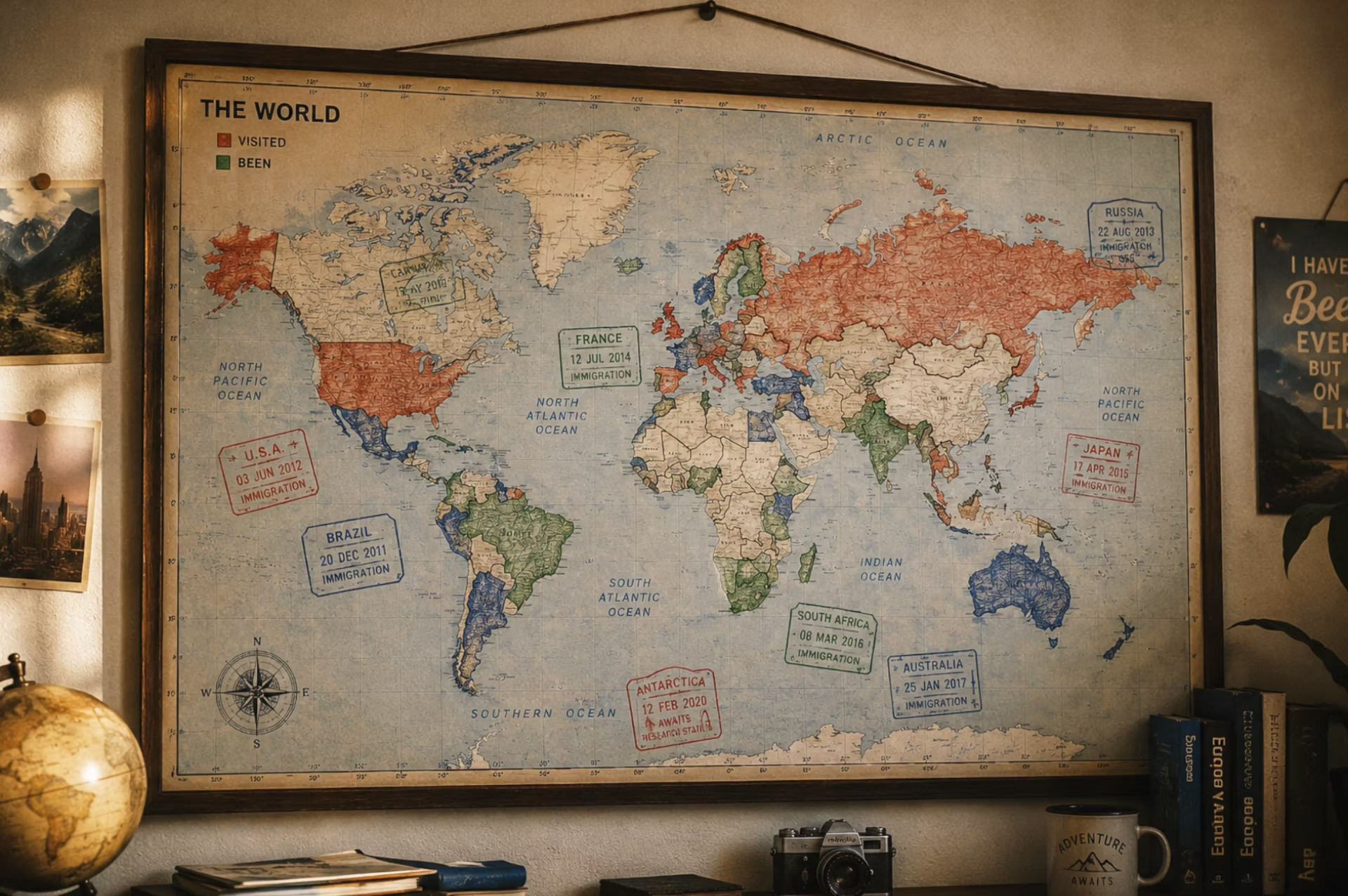
Here's a small, slightly embarrassing test. Without looking anything up, try to name every country you've ever set foot in. Most people get a confident run going, stall somewhere in the teens, and then spend the next ten minutes going "wait, does that layover count, and did we actually leave the airport in Doha that time?" The trips blur. The order slips. A whole country can quietly fall out of the list just because it was a long time ago.
That's the real reason to track the countries you've visited. Not to win an argument about your number, but because the act of keeping the list is how the trips stay yours. So here are six ways to actually do it, ordered from the most analog to the most digital, with an honest take on what each one is good at and where it quietly falls apart. There's no single right answer. There's the one you'll actually keep up.
1. The classic notebook 📓
The oldest method, and still a lovely one. A small notebook in your bag, a page per country or per trip, a line of ink the day you arrive. There's something about writing it by hand that a tap on a screen never quite matches. The notebook becomes an object with weight and coffee stains and your own handwriting getting messier as the flight gets longer.
What it's good at: it never runs out of battery, it asks for nothing, and it's genuinely beautiful to flip through years later. Where it falls apart: there's exactly one copy, and it lives in a bag that goes through airports. Lose it and the whole record is gone, with no backup anywhere. It also can't add anything up, draw you a map, or tell you how many countries you're actually on.
Best for: people who love the ritual of writing and treat the notebook itself as the souvenir.
2. A scratch map on the wall 🗺️
You know the ones. A world map with a gold foil layer you scratch off country by country to reveal the color underneath. It's the most satisfying method on this list, a little physical reward every time you get home, and it turns a blank wall into a record of your life that guests actually stop and read.
What it's good at: pure visual joy, and it makes a genuinely great gift. Where it falls apart: it doesn't travel with you, it doesn't sync anywhere, and once it's scratched it's permanent, so there's no undo and no detail beyond "been there." It tells you the shape of where you've been, but nothing about when or what it was like.
Best for: people who want one beautiful object on the wall and don't need the data to do anything clever.
3. A spreadsheet
Unglamorous, and quietly the most powerful option for a certain kind of person. A few columns, country, year, city, a note, a link to a photo folder, and suddenly you can sort, filter, count, and search your entire travel history in seconds. It costs nothing and you already know how to use it.
What it's good at: total control and real data. You can answer questions a fancier tool won't, like "every country I visited in my twenties" or "all the places I went with Mum." Where it falls apart: nobody enjoys opening a spreadsheet on holiday, so the updating tends to lapse, and it gives you zero of the warmth. A row that says "France, 2019" is accurate and a little joyless.
Best for: organizers and data people who genuinely like a clean sheet.
4. Photo albums grouped by location
This is the method you're already doing without trying. Both Google Photos and Apple Photos now sort your pictures by place automatically, so your phone is quietly building a map of everywhere you've been as a free side effect of taking photos at all. Open the Places view and there it is, pins scattered across a world map.
What it's good at: it requires no effort and the memories are right there attached to each spot, which is more than most dedicated trackers give you. Where it falls apart: it only knows the countries you took photos in, so a quick border crossing with no pictures simply doesn't exist, and it can't give you a clean count or a proper "countries visited" list. It's a map of your photos, not a record of your travels, and the two aren't quite the same.
Best for: people who take a lot of photos and just want to see roughly where they've been without setting anything up.
5. Google My Maps 📍
A step up from the photo map if you want to build something deliberate. With Google My Maps you can drop a custom pin on every place you've been, color-code them, add notes, and share the whole thing with a link. It's free, flexible, and great for collaborating, like a shared map of everywhere you and a friend have been between you.
What it's good at: customization and sharing. Where it falls apart: it's fiddly to maintain by hand, it isn't designed for travel specifically so there's no count or collection logic, and a map full of manually dropped pins slowly turns into admin. It's a tool you bend into a tracker rather than one built to be one.
Best for: people who like building something custom and want to share a map with others.
6. A travel-tracking app, or a digital passport
Eventually most people who care about this land on an app built for exactly this, because it does the parts the other methods can't: it counts automatically, draws the map for you, keeps everything backed up, and travels in your pocket. Apps like Visited and Been do the core job of tapping countries on a map to get a running total, and they're a fine place to start if all you want is the number.
This is the one I'm biased about, because filling the gap between "a cold count" and "a record worth keeping" is the whole reason I built Stampie. It's the old passport stamp reimagined for today's digital world: instead of just a tally, you collect a travel stamp for each country you visit, a passport fills in as you go, and you can keep a note with each one so the story stays attached to the place. It lives on your phone, it's backed up, and the booklet doesn't end up at the bottom of a drawer.


What it's good at: it does everything the analog methods do separately, counting, mapping, remembering, in one place that syncs and survives a lost phone. Where it falls apart: it's a screen, and a screen will never give you the exact tactile pleasure of scratching gold foil off a wall. Nothing digital quite will. But it's the only method on this list that can keep up with you for decades without much effort to maintain.
Best for: pretty much anyone who wants the count, the map, and the memories without maintaining three separate things. And honestly, for anyone who misses the passport stamp itself, now that the inked stamp is quietly disappearing at borders worldwide.
Bonus: Countries visited checklist 🌍
Enough reading, here's the fun part. Check off every country you've already been to and watch your number climb. Your progress saves on this device, so you can come back and keep going, and there's a Download as PDF button for a printable checklist to keep or stick on the wall.
Countries visited checklist
0 of 249Add them to your passport in Stampie
This list is saved on this device. In Stampie, each one becomes a passport stamp. Add your photos and the dates you went, and keep your progress synced across your phone and the web.
Prefer a map to a list? Our free countries visited map colors in every country you tap, no sign-up needed, and there are more free travel tools and travel games where that came from.
So which one should you actually use?
If you only want a number, any tracking app, Stampie or Visited, gets you there in a couple of minutes. If you want to share where you've been, a Google My Map or a Stampie profile does the job. If you love physical objects, a notebook and a scratch map together are hard to beat. And if you want one thing that does the count, the map, and the memories and still works in ten years, that's exactly the gap a digital passport is built to fill.
Honestly, the best method is the boring answer: the one you'll keep up with. A perfect system you abandon after two trips loses to a scrappy one you actually maintain. Pick the option that fits how your brain works, start with the countries you can remember right now, and let it fill in from there.
FAQ
What's the best app to count countries you've visited? For a simple count, Visited and Been both do it well. For more than a number, collections, a passport that fills in, notes on each place, and share cards, Stampie is built around exactly that.
Is there a free app to track countries visited? Yes. Most apps in this space, including Stampie and Visited, have a free tier that covers tracking and counting your countries.
Is there a free countries-visited checklist? Yes. This page has an interactive checklist of every country that you can tick off, with your progress saved on your device, plus a free countries visited map you can color in. Neither needs an account.
Can I download or print the countries checklist as a PDF? Yes. Tick off the countries above, then hit Download as PDF under the checklist. You get a clean, printable page with a checkbox next to every country and your progress at the top, grouped to fit the page. No sign-up, so you can print it for the fridge or keep it on your phone.
How do I track countries visited on a spreadsheet? Use Google Sheets or any spreadsheet tool with columns for country, year, city, a note, and a photo link. It's sortable, filterable, free, and fully yours, though you'll have to remember to actually update it.
Do photo apps count as tracking countries? Sort of. Google Photos and Apple Photos map your pictures by location automatically, which is a great rough view, but they only know the places you took photos and can't give you a clean countries-visited count.
What's the easiest way to keep the list updated? An app you carry anyway, because the updating happens in the moment instead of as a chore later. The methods people abandon are the ones that ask you to sit down at a desk to maintain them.
How many countries are there to visit? There are 195 sovereign countries in the world, the 193 UN member states plus the Holy See and Palestine. But there's more to set foot in than that. Alongside them, Stampie also tracks the sovereign territories and dependencies you can actually visit, so the checklist above adds up to around 250 places in total. Tick them off and you'll see exactly how many you have left.
Does a layover or airport count as a country visited? That's the great travel debate, and honestly it's your call. Most people only count a country if they left the airport and actually set foot in it. Whichever rule you pick, the trick is to be consistent so your number means the same thing every time.
Behind Stampie

The idea for Stampie started in Peru 🇵🇪, back in 2023. I’ve always loved collecting passport stamps, that small thrill of seeing a new one land at the border. On that trip they just waved me through. No stamp. A small thing, but it stuck with me.
Turns out a lot of countries have quietly stopped stamping. A couple of years later I built the first version of Stampie for a hackathon, somewhere to keep that little ritual alive even when the ink doesn’t come. A passport-style journal for anyone who still wants this souvenir from every trip.
It quietly found its way to people. As an indie team, we keep working on Stampie in coffee breaks, on weekends, and from wherever the next trip takes us.

You might also like


How this post was made: AI-assisted tools may be used in research, drafting and image generation, then reviewed and edited by the author. Travel policies change quickly. For visa, border, and entry requirements, please check primary sources (official immigration sites, your embassy) before you go.
Spotted an error or something that doesn't look right? Report a concern and we'll take a look.